

Where it will be visible
Check the path of totality and choose a spot with good sky visibility. Access the IGN's official interactive map to locate the best areas.
Interactive map12 August 2026 - Galicia
An exceptional astronomical event that will be visible from much of Galicia
On this page we will bring together practical information and official links to plan your experience: where to look, when to look and how to do it safely. The contents will be progressively completed and validated.
Check the path of totality and choose a spot with good sky visibility. Access the IGN's official interactive map to locate the best areas.
Interactive mapAccess estimated schedules based on your location through the official viewer. In this section, we will include a summary by province.
Go to schedulesClear recommendations for observing the eclipse safely, with links and reference materials.
See recommendationsNote: in August, Galicia is on Daylight Saving Time (CEST, UTC+2). Official times may differ from the ‘actual sunset’ if your western horizon is not flat.
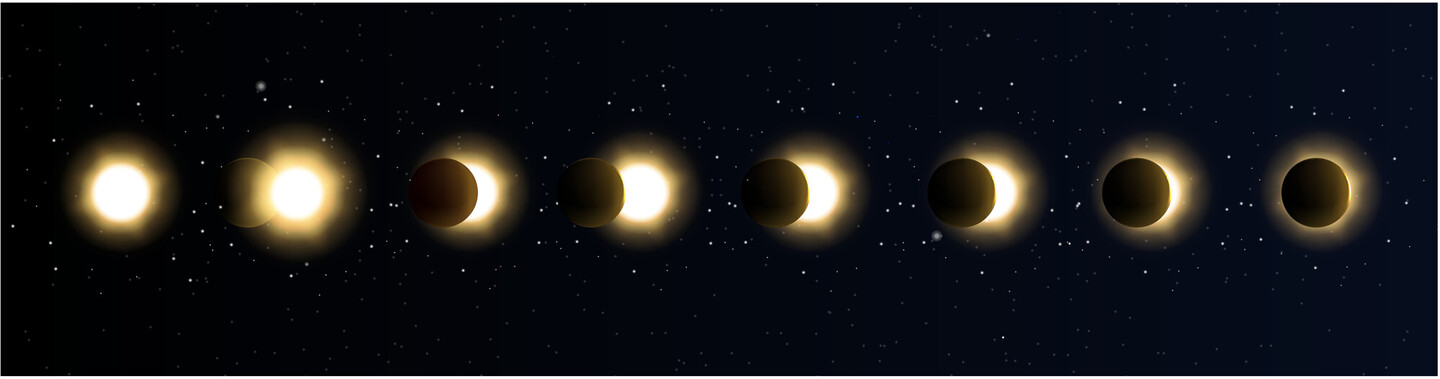
A solar eclipse occurs when the moon passes in front of the sun and casts its shadow on Earth. In the case of a total eclipse, the darkest part of the shadow (umbra) covers your location for a few moments: the day ‘goes out’, the temperature drops, and the solar corona becomes visible.
The Sun looks ‘bitten’. At no time is it completely covered.
The moon covers the centre, but a bright ‘ring’ remains around it.
The sun is completely covered during totality. It is the most spectacular experience.
The path of totality is narrow: only locations passed by the moon's shadow see it in full. In 2026, that trajectory crosses the north-west of the peninsula and covers a good part of Galicia.

The eclipse of 12 August 2026, will be seen as total within a specific path. In Galicia, the phenomenon occurs in the late afternoon, with the sun low on the horizon. As a reference, in the municipality of A Coruña, the IGN indicates that the eclipse ends around 21:22 (official time), before sunset. Please note: actual visibility may vary if you have mountains, buildings, or other obstacles to the west, so choosing a location with a clear horizon is key.
This map allows you to check if a specific municipality is within the path of totality.
Province with a clear presence of totality. The capital (A Coruña) is in totality as well as many municipalities in the metropolitan area and the north/interior. In the south-west and in some coastal areas the eclipse may remain partial.
It is the Galician province with the greatest presence within the path of totality. Most of the area will be in totality (including the capital).
‘Contrast’ province: mostly partial, with totality in some municipalities. Totality is concentrated mainly in the east/south-east (Valdeorras and mountain areas), whereas in the vicinity of Ourense city and much of the rest, the partial eclipse predominates.
Partial eclipse predominates, with totality only in specific inland municipalities. In most of the province the magnitude is very high but without totality; the best spots are in specific inland areas.
These sheets are an official summary for the capitals (not for the entire province). To confirm totality at your exact location, use the IGN viewer.

Start 19:31 · Maximum 20:28 · End 21:22
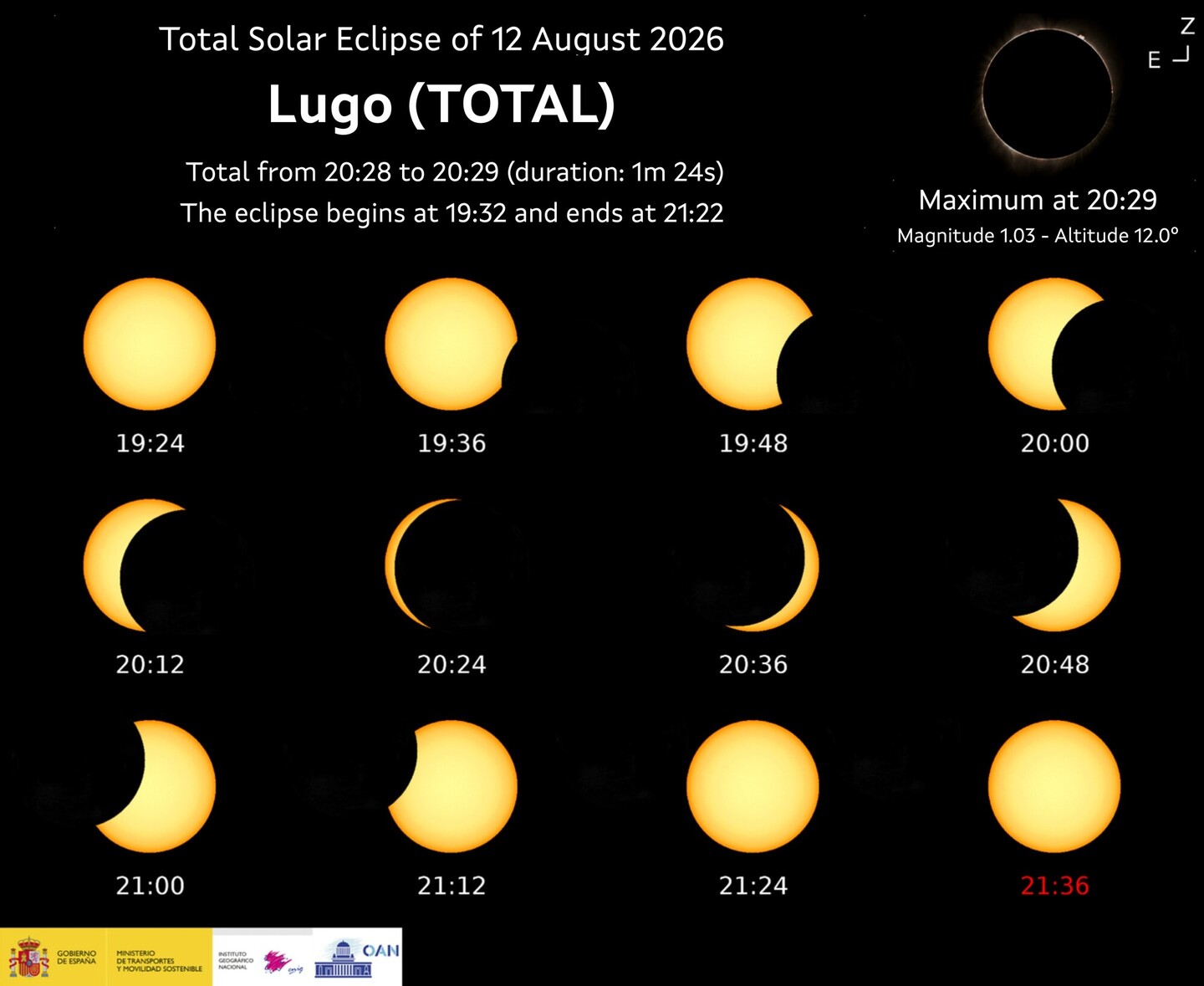
Start 19:32 · Maximum 20:29 · End 21:22

Start 19:33 · Maximum 20:30 · End 21:23
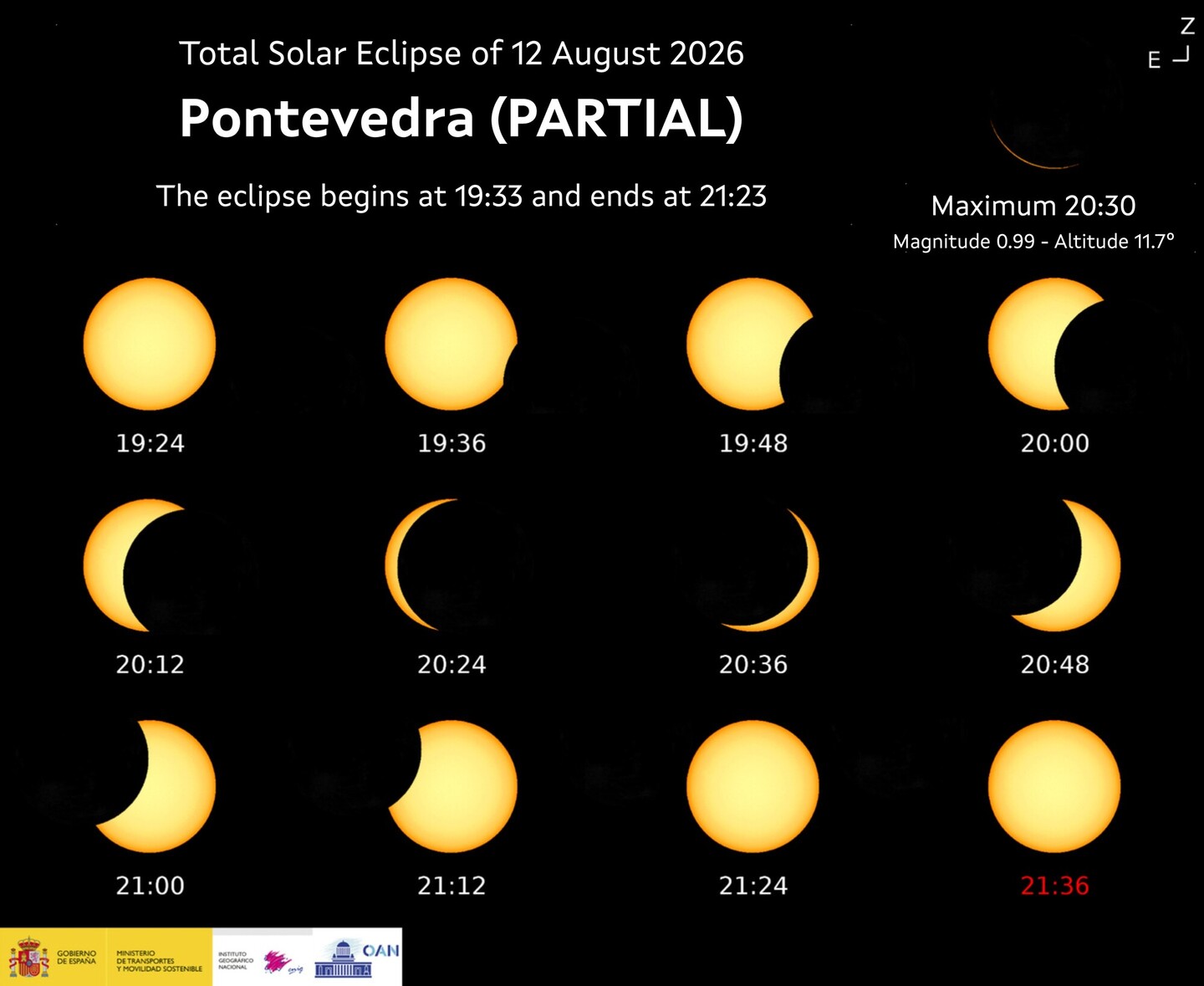
Start 19:33 · Maximum 20:30 · End 21:23
Source: IGN/CNIG (eclipse portal). Please reproduce the logos and keep the material unaltered
Search for your municipality and consult the official eclipse schedules. Municipalities with TOTALITY show the start/end of totality; the rest will see a PARTIAL eclipse. Official time (CEST, UTC+2).
The sun will be very low toward the west/west-north-west at the eclipse maximum. Choose a location with a clear western horizon.
| Municipality | Type | Maximum | Totality | Magnitude |
|---|
Protecting your eyesight is essential. Looking at the sun without suitable protection can cause permanent eye damage.
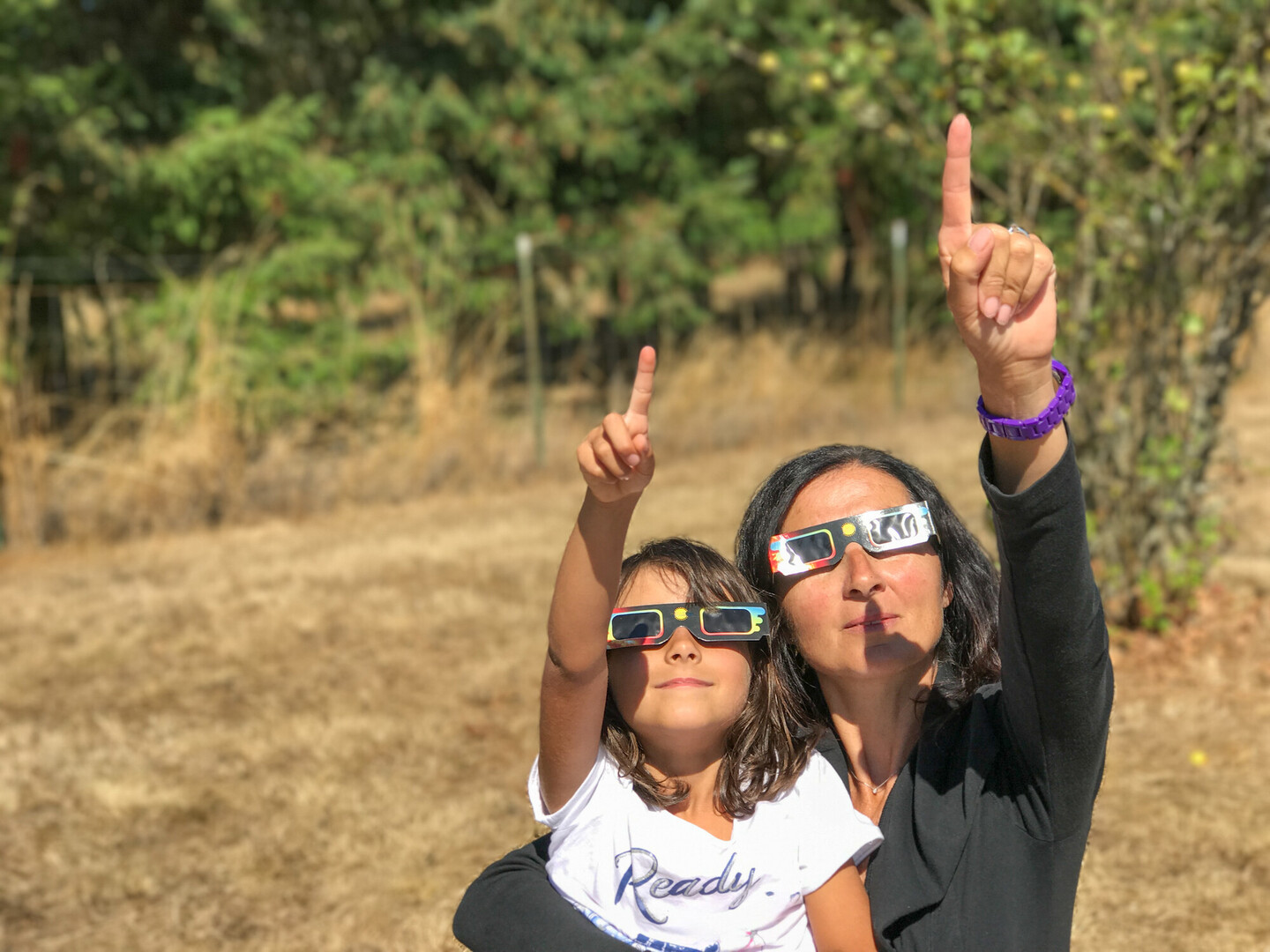
To observe the eclipse safely it is essential to use:
Here we will gather verified links (maps, calculations, safety tips, and educational materials). We will add brief descriptions and attribution notes where appropriate.
Initial list of resources. We will expand it with validated content.
Here is a selection of special offers so you can enjoy the eclipse at some of Galicia’s unique destinations:
Maybe some resources are not geo-referenced and they are not being displayed.